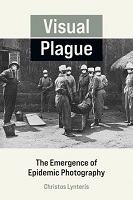
Visual Plague
The Emergence of Epidemic Photography
| dc.contributor.author | Lynteris, Christos | |
| dc.date.accessioned | 2023-07-19T08:51:46Z | |
| dc.date.available | 2023-07-19T08:51:46Z | |
| dc.date.issued | 2022 | |
| dc.date.submitted | 2023-07-11T11:18:42Z | |
| dc.identifier | https://library.oapen.org/handle/20.500.12657/63860 | |
| dc.identifier.uri | https://directory.doabooks.org/handle/20.500.12854/101649 | |
| dc.description.abstract | How epidemic photography during a global pandemic of bubonic plague contributed to the development of modern epidemiology and our concept of the “pandemic.” In Visual Plague, Christos Lynteris examines the emergence of epidemic photography during the third plague pandemic (1894–1959), a global pandemic of bubonic plague that led to over twelve million deaths. Unlike medical photography, epidemic photography was not exclusively, or even primarily, concerned with exposing the patient's body or medical examinations and operations. Instead, it played a key role in reconceptualizing infectious diseases by visualizing the “pandemic” as a new concept and structure of experience—one that frames and responds to the smallest local outbreak of an infectious disease as an event of global importance and consequence. As the third plague pandemic struck more and more countries, the international circulation of plague photographs in the press generated an unprecedented spectacle of imminent global threat. Nothing contributed to this sense of global interconnectedness, anticipation, and fear more than photography. Exploring the impact of epidemic photography at the time of its emergence, Lynteris highlights its entanglement with colonial politics, epistemologies, and aesthetics, as well as with major shifts in epidemiological thinking and public health practice. He explores the characteristics, uses, and impact of epidemic photography and how it differs from the general corpus of medical photography. The new photography was used not simply to visualize or illustrate a pandemic, but to articulate, respond to, and unsettle key questions of epidemiology and epidemic control, as well as to foster the notion of the “pandemic,” which continues to affect our lives today. | |
| dc.language | English | |
| dc.rights | open access | |
| dc.subject.other | Epedemics; history; photography | |
| dc.subject.other | thema EDItEUR::A The Arts::AJ Photography and photographs | |
| dc.title | Visual Plague | |
| dc.title.alternative | The Emergence of Epidemic Photography | |
| dc.type | book | |
| oapen.identifier.doi | 10.7551/mitpress/14413.001.0001 | |
| oapen.relation.isPublishedBy | ae0cf962-f685-4933-93d1-916defa5123d | |
| oapen.relation.hasChapter | Chapter 4 The Global War Against the Rat | |
| oapen.relation.hasChapter | 0cb89f91-7c70-445d-8707-7916003a1c60 | |
| oapen.relation.isbn | 9780262544221 | |
| oapen.relation.isbn | 9780262544221 | |
| oapen.place.publication | Cambridge |
Files in this item
| Files | Size | Format | View |
|---|---|---|---|
|
There are no files associated with this item. |
|||
This item appears in the following Collection(s)
Chapters in this book
-
(2022)It is almost impossible to find a plague-related news item today that is not accompanied by an image of a rat. The best-known carriers of zoonotic diseases, rats are so closely identified with plague that research ...
-
(2022)It is almost impossible to find a plague-related news item today that is not accompanied by an image of a rat. The best-known carriers of zoonotic diseases, rats are so closely identified with plague that research ...