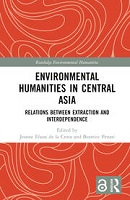
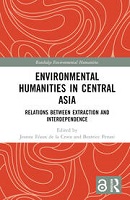
Environmental Humanities in Central Asia
Relations Between Extraction and Interdependence
| dc.contributor.editor | Feaux de la Croix, Jeanne | |
| dc.contributor.editor | Penati, Beatrice | |
| dc.date.accessioned | 2023-11-17T09:02:49Z | |
| dc.date.available | 2023-11-17T09:02:49Z | |
| dc.date.issued | 2024 | |
| dc.date.submitted | 2023-08-28T10:15:40Z | |
| dc.identifier | https://library.oapen.org/handle/20.500.12657/75839 | |
| dc.identifier.uri | https://directory.doabooks.org/handle/20.500.12854/121927 | |
| dc.description.abstract | This book is the first collection to showcase the flourishing field of environmental humanities in Central Asia. A region larger than Europe, Central Asia possesses an astounding range of environments, from deserts to glaciated peaks. The volume brings into conversation scholarship from history to social anthropology, demonstrating the contribution that interdisciplinary and engaged research offers to many urgent issues in the region: from the history of conservationism to the tactics of environmental movements, from literary engagements with ‘pure nature’ to the impact of fossil fuel extraction. The collection focuses on the Central Asian republics of the former USSR, where a complex layering of nomadic and sedentary, Turkic and Persianate, Islamic and Soviet cultures ends up affecting human relations with distinct environments. Featuring state-of-the-art contributions, the book enquires into human-environment relations through a broad-brush typology of interactive modes: to extract, protect, enspirit and fear. Broadening the scope of analysis beyond a consideration of power, the authors bring into focus alternative local cosmologies and the unintended consequences of environmental policy. The volume highlights scholarship from within Central Asia as well as expertise elsewhere, offering readers diverse modes of knowledge-production in the environmental humanities. This book is an important resource for researchers and students of the environmental humanities, sustainability, history, politics, anthropology and geography of Asia, as well as Soviet and Post-Soviet studies. | |
| dc.language | English | |
| dc.rights | open access | |
| dc.subject.other | Central Asia; Environmental history; Environmental humanities; Extractivism; Kazakhstan; Kyrgyzstan; Post-Soviet Studies; Sustainability; Tajikistan; Uzbekistan | |
| dc.title | Environmental Humanities in Central Asia | |
| dc.title.alternative | Relations Between Extraction and Interdependence | |
| dc.type | book | |
| oapen.identifier.doi | 10.4324/9781003362364 | |
| oapen.relation.isPublishedBy | fa69b019-f4ee-4979-8d42-c6b6c476b5f0 | |
| oapen.relation.hasChapter | Chapter 11 The power of apricot | |
| oapen.relation.hasChapter | cf29449a-519c-47b9-801c-36ec0e009c9a | |
| oapen.relation.isbn | 9781032423418 | |
| oapen.relation.isbn | 9781032423432 | |
| oapen.relation.isbn | 9781003362364 | |
| oapen.imprint | Routledge |
Fichier(s) constituant ce document
| Fichiers | Taille | Format | Vue |
|---|---|---|---|
|
Il n'y a pas de fichiers associés à ce document. |
|||
Ce document figure dans la(les) collection(s) suivante(s)
Chapters in this book
-
(2024)The apricot has a strong economic value in disputed areas along the Kyrgyzstan-Tajikistan border. It is also an important asset for migrant workers investments. This paper argues that tree's life cycle produces power ...
-
(2024)The apricot has a strong economic value in disputed areas along the Kyrgyzstan-Tajikistan border. It is also an important asset for migrant workers investments. This paper argues that tree's life cycle produces power ...