| dc.contributor.editor | Susam-Saraeva, Sebnem | |
| dc.contributor.editor | Spišiaková, Eva | |
| dc.date.accessioned | 2023-11-17T09:05:35Z | |
| dc.date.available | 2023-11-17T09:05:35Z | |
| dc.date.issued | 2021 | |
| dc.date.submitted | 2023-09-13T08:43:32Z | |
| dc.identifier | https://library.oapen.org/handle/20.500.12657/76209 | |
| dc.identifier.uri | https://directory.doabooks.org/handle/20.500.12854/121947 | |
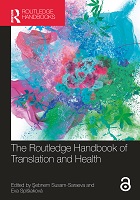
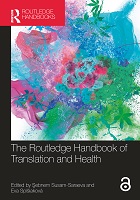
| dc.description.abstract | The Routledge Handbook of Translation and Health provides a bridge between translation studies and the burgeoning field of health humanities, which seeks novel ways of understanding health and illness. As discourses around health and illness are dependent on languages for their transmission, impact, spread, acceptance and rejection in local settings, translation studies offers a wealth of data, theoretical approaches and methods for studying health and illness globally. Translation and health intersect in a multitude of settings, historical moments, genres, media and users. This volume brings together topics ranging from interpreting in healthcare settings to translation within medical sciences, from historical and contemporary travels of medicine through translation to areas such as global epidemics, disaster situations, interpreting for children, mental health, women’s health, disability, maternal health, queer feminisms and sexual health, and nutrition. Contributors come from a wide range of disciplines, not only from various branches of translation and interpreting studies, but also from disciplines such as psychotherapy, informatics, health communication, interdisciplinary health science and classical Islamic studies. Divided into four sections and each contribution written by leading international authorities, this timely Handbook is an indispensable resource for all students and researchers of translation and health within translation and interpreting studies, as well as medical and health humanities.The Routledge Handbook of Translation and Health provides a bridge between translation studies and the burgeoning field of health humanities, which seeks novel ways of understanding health and illness. As discourses around health and illness are dependent on languages for their transmission, impact, spread, acceptance and rejection in local settings, translation studies offers a wealth of data, theoretical approaches and methods for studying health and illness globally. Translation and health intersect in a multitude of settings, historical moments, genres, media and users. This volume brings together topics ranging from interpreting in healthcare settings to translation within medical sciences, from historical and contemporary travels of medicine through translation to areas such as global epidemics, disaster situations, interpreting for children, mental health, women’s health, disability, maternal health, queer feminisms and sexual health, and nutrition. Contributors come from a wide range of disciplines, not only from various branches of translation and interpreting studies, but also from disciplines such as psychotherapy, informatics, health communication, interdisciplinary health science and classical Islamic studies. Divided into four sections and each contribution written by leading international authorities, this timely Handbook is an indispensable resource for all students and researchers of translation and health within translation and interpreting studies, as well as medical and health humanities. | |
| dc.language | English | |
| dc.rights | open access | |
| dc.subject.other | Ancient Chinese Medicine, Ayurvedic Texts, Child language brokering, Community interpreting, Disability and translation, Ethics of translation in healthcare settings, Eva Spišiaková, Health humanities, Interpreting in children's health, Knowledge translation in medicine, Medical terminology and discourse, Mental illness, Narratives of health and illness, Nutrition and translation, Remote interpreting, Routledge Handbook of Translation and Health, Sexual health, Sexuality, gender and health, Sign language interpreting, Sports and translation, Translation and global health, Translation and interpreting in healthcare settings, Translation and pharmaceuticals, Translation and women's health, Translation in alternative medicine, Translation in medicine and medical sciences, Translation studies, Translations of ancient texts on health and illness, Women's health | |
| dc.title | The Routledge Handbook of Translation and Health | |
| dc.type | book | |
| oapen.identifier.doi | 10.4324/9781003167983 | |
| oapen.relation.isPublishedBy | fa69b019-f4ee-4979-8d42-c6b6c476b5f0 | |
| oapen.relation.hasChapter | Chapter Introduction: Beyond translation and medicine | |
| oapen.relation.hasChapter | cabc4edc-c363-4b5e-a4c2-657a25d8db22 | |
| oapen.relation.hasChapter | Chapter 18 Disability in translation | |
| oapen.relation.hasChapter | 74b89ca9-ec76-4041-a040-069610125a6f | |
| oapen.relation.isbn | 9781003167983 | |
| oapen.relation.isbn | 9781138335349 | |
| oapen.relation.isbn | 9780367766672 | |
| oapen.imprint | Routledge | |