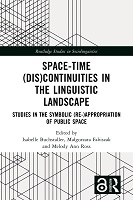
Space-Time (Dis)continuities in the Linguistic Landscape
Studies in the Symbolic (Re-)appropriation of Public Space
| dc.contributor.editor | Buchstaller, Isabelle | |
| dc.contributor.editor | Fabiszak, Malgorzata | |
| dc.contributor.editor | Ross, Melody Ann | |
| dc.date.accessioned | 2024-03-20T04:05:39Z | |
| dc.date.available | 2024-03-20T04:05:39Z | |
| dc.date.issued | 2024 | |
| dc.date.submitted | 2024-03-19T11:02:50Z | |
| dc.identifier | https://library.oapen.org/handle/20.500.12657/88632 | |
| dc.identifier.uri | https://directory.doabooks.org/handle/20.500.12854/135813 | |
| dc.description.abstract | This collection spotlights the diachronic dimensions of the linguistic landscape, the importance of exploring temporal dissonances in historical events in order to better understand semiotic, political, and social transformations across different communities over the last century. The volume seeks to expand the current borders of linguistic landscape (LL) research by situating the analysis of signs in the LL within their time–space organization, which has been understudied in existing scholarship. The book, featuring chapters from established and emerging scholars, argues that a focus on the historicity of the city text can reveal unique insights into the role of semiotic processes as precursors and support mechanisms for political and social changes. The collection is structured around different temporal clusters and geographic contexts across the globe where shorter and longer waves of politically driven resemioticization can be most sharply observed– post-colonial communities; post-communist societies; and recent and current sociopolitical upheavals. Taken together, the volume proposes a kaleidoscope view of the complex temporalities that underpin multimodal discourses in contested public spaces, offering new directions for research. This book will be of interest to students and scholars in sociolinguistics, discourse analysis, semiotics, visual anthropology, and political science. | |
| dc.language | English | |
| dc.relation.ispartofseries | Routledge Studies in Sociolinguistics | |
| dc.rights | open access | |
| dc.subject.other | Melody Ann Ross,Malgorzata Fabiszak,Isabelle Buchstaller,semiotics,discourse analysis,sociolinguistics,multimodal discourses in public spaces,politically-driven re-semioticization,citytext,linguistic landscape | |
| dc.subject.other | thema EDItEUR::C Language and Linguistics::CB Language: reference and general | |
| dc.subject.other | thema EDItEUR::C Language and Linguistics::CF Linguistics | |
| dc.title | Space-Time (Dis)continuities in the Linguistic Landscape | |
| dc.title.alternative | Studies in the Symbolic (Re-)appropriation of Public Space | |
| dc.type | book | |
| oapen.identifier.doi | 10.4324/9781003311621 | |
| oapen.relation.isPublishedBy | fa69b019-f4ee-4979-8d42-c6b6c476b5f0 | |
| oapen.relation.hasChapter | Chapter Introduction | |
| oapen.relation.hasChapter | d81f1e7c-0d3f-46a2-9666-3bb7ca8396b4 | |
| oapen.relation.hasChapter | Chapter 8 Commemorative street naming practices in the border towns Frankfurt (Oder)/Słubice | |
| oapen.relation.hasChapter | d407403f-0265-4358-9038-112620c0bd28 | |
| oapen.relation.isbn | 9781032318448 | |
| oapen.relation.isbn | 9781032318493 | |
| oapen.relation.isbn | 9781003311621 | |
| oapen.imprint | Routledge |
Fichier(s) constituant ce document
| Fichiers | Taille | Format | Vue |
|---|---|---|---|
|
Il n'y a pas de fichiers associés à ce document. |
|||
Ce document figure dans la(les) collection(s) suivante(s)
Chapters in this book
-
(2022)"With a combined focus on social democrats in Northern and Southern Europe, this book crucially broadens our understanding of the transformation of European social democracy from the mid-1970s to the early-1990s. In doing ...
-
(2024)This collection spotlights the diachronic dimensions of the linguistic landscape, the importance of exploring temporal dissonances in historical events in order to better understand semiotic, political, and social ...
-
(2024)This collection spotlights the diachronic dimensions of the linguistic landscape, the importance of exploring temporal dissonances in historical events in order to better understand semiotic, political, and social ...