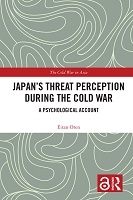
Japan’s Threat Perception During the Cold War
A Psychological Account
| dc.contributor.author | Oren, Eitan | |
| dc.date.accessioned | 2025-01-19T13:42:54Z | |
| dc.date.available | 2025-01-19T13:42:54Z | |
| dc.date.issued | 2023 | |
| dc.date.submitted | 2024-11-12T08:40:05Z | |
| dc.identifier | https://library.oapen.org/handle/20.500.12657/94556 | |
| dc.identifier.uri | https://doab-dev.siscern.org/handle/20.500.12854/148361 | |
| dc.description.abstract | Oren re-examines Japan’s threat perception during the first two decades of the Cold War, using a wide range of source materials, including many unavailable in English, or only recently declassified. There is a widely shared misconception that during the Cold War the Japanese were largely shielded from threats due to the American military protection, the regional balance of power, Japan’s geographical insularity, and domestic aversion to militarism. Oren dispels this, showing how security threats pervaded Japanese strategic thinking in this period. By dispelling this misconception, Oren enables us to more accurately gauge the degree to which Japan’s threat perception has evolved during and after the end of the Cold War and to enhance our understanding of Tokyo’s strategic calculus in the current situation of rivalry between China and the United States. This book will be of great value to both scholars of Japanese history and contemporary international relations. | |
| dc.language | English | |
| dc.relation.ispartofseries | The Cold War in Asia | |
| dc.rights | open access | |
| dc.subject.other | Pacific,Security,North Korea,Threat Perception,Cold War Japan,West Germany,Early Cold War,SDF Personnel,Indirect Aggression,Early Cold War Period,Motivated Bias,Diet Deliberations,Military Expenditures,LDP,Military Security Issues,Hypothetical Enemies,Japan’s Nuclear Policy,Early Cold War Era,Domestic Political Contestation,Japan’s Nuclear Option,SCAP,Large Scale Rearmament,Securitization Move,Soviet Military Threat,SDF Mission,Non-Nuclear Principles,Book’s Findings,ICBM | |
| dc.subject.other | thema EDItEUR::N History and Archaeology::NH History::NHF Asian history | |
| dc.subject.other | thema EDItEUR::N History and Archaeology::NH History::NHB General and world history | |
| dc.subject.other | thema EDItEUR::G Reference, Information and Interdisciplinary subjects::GT Interdisciplinary studies::GTM Regional / International studies | |
| dc.title | Japan’s Threat Perception During the Cold War | |
| dc.title.alternative | A Psychological Account | |
| dc.type | book | |
| oapen.identifier.doi | 10.4324/9781003241324 | |
| oapen.relation.isPublishedBy | fa69b019-f4ee-4979-8d42-c6b6c476b5f0 | |
| oapen.relation.hasChapter | Chapter 1 Japan’s threat perception – introduction | |
| oapen.relation.hasChapter | cfee0878-89b8-4b0e-aab7-035e2c535cd8 | |
| oapen.relation.hasChapter | Chapter 4 Explaining Japan’s threat perception | |
| oapen.relation.hasChapter | b1203620-2f42-41f2-a165-a60605b00b9d | |
| oapen.relation.isbn | 9781003241324 | |
| oapen.relation.isbn | 9781032148298 | |
| oapen.relation.isbn | 9781032148304 | |
| oapen.imprint | Routledge |
Files in this item
| Files | Size | Format | View |
|---|---|---|---|
|
There are no files associated with this item. |
|||
This item appears in the following Collection(s)
Chapters in this book
-
(2023)Oren re-examines Japan’s threat perception during the first two decades of the Cold War, using a wide range of source materials, including many unavailable in English, or only recently declassified. There is a widely shared ...
-
(2023)Oren re-examines Japan’s threat perception during the first two decades of the Cold War, using a wide range of source materials, including many unavailable in English, or only recently declassified. There is a widely shared ...
-
(2023)Oren re-examines Japan’s threat perception during the first two decades of the Cold War, using a wide range of source materials, including many unavailable in English, or only recently declassified. There is a widely shared ...