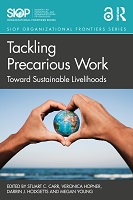
Tackling Precarious Work
Toward Sustainable Livelihoods
| dc.contributor.editor | Carr, Stuart | |
| dc.contributor.editor | Hopner, Veronica | |
| dc.contributor.editor | Hodgetts, Darrin J. | |
| dc.contributor.editor | Young, Megan | |
| dc.date.accessioned | 2025-03-07T15:04:07Z | |
| dc.date.available | 2025-03-07T15:04:07Z | |
| dc.date.issued | 2024 | |
| dc.date.submitted | 2023-10-18T11:49:17Z | |
| dc.identifier | OCN: 1379019356 | |
| dc.identifier | https://library.oapen.org/handle/20.500.12657/76854 | |
| dc.identifier.uri | https://doab-dev.siscern.org/handle/20.500.12854/155569 | |
| dc.description.abstract | Tackling precarious work has been described by the United Nations (UN)’s International Labour Organization (ILO) as the main challenge facing the world of work. In this ground-breaking book, leading applied research scholars, advocates, and activists from across the globe respond to this challenge by showing how Industrial and Organizational (I/O) psychology has a significant contribution to make in humanity moving away from precarious work situations towards sustainable livelihoods. Broken down into four key parts on Sustainable Livelihoods, Fair Incomes, Work Security and Social Protection, the book covers a multitude of topics including the role of poor pay, lack of work-related security, social protection for human health and wellbeing, and interventions and policies to implement for the future of work. The volume offers a detailed look into useful and effective ways to tackle precarious work to create and maintain sustainable livelihoods. This curated collection of 22 chapters considers the broader relationships between previous research work and issues of human security and sustainability that affect workers, families, communities, and societies. Each chapter expands the present understandings of the world of precarious work and how it fits within broader issues of economic, ecological, and social sustainability. In addition to I/O psychologists in research, practice, service and study, this book will also be useful for organizational researchers, labor unions, HR practitioners, fair trade, cooperative, and civil society organizations, social scientists, human security analysts, public health professionals, economists, and supporters of the UN SDGs, including at the UN. | |
| dc.language | English | |
| dc.relation.ispartofseries | SIOP Organizational Frontiers Series | |
| dc.rights | open access | |
| dc.subject.other | "Stuart C. Carr, Veronica Hopner, Darrin J. Hodgetts, Megan Young, Livelihoods, Precarious, Sustainable, Tackling, Work" | |
| dc.title | Tackling Precarious Work | |
| dc.title.alternative | Toward Sustainable Livelihoods | |
| dc.type | book | |
| oapen.identifier.doi | 10.4324/9781003440444 | |
| oapen.relation.isPublishedBy | fa69b019-f4ee-4979-8d42-c6b6c476b5f0 | |
| oapen.relation.hasChapter | Chapter 1 From Precarious Work to Sustainable Livelihoods | |
| oapen.relation.isbn | 9781032576657 | |
| oapen.relation.isbn | 9781032576633 | |
| oapen.relation.isbn | 9781003440444 | |
| oapen.imprint | Routledge | |
| oapen.pages | 602 | |
| peerreview.review.type | Proposal | |
| peerreview.anonymity | Single-anonymised | |
| peerreview.reviewer.type | Internal editor | |
| peerreview.reviewer.type | External peer reviewer | |
| peerreview.review.stage | Pre-publication | |
| peerreview.open.review | No | |
| peerreview.publish.responsibility | Publisher | |
| peerreview.id | bc80075c-96cc-4740-a9f3-a234bc2598f1 | |
| peerreview.title | Proposal review |
Files in this item
| Files | Size | Format | View |
|---|---|---|---|
|
There are no files associated with this item. |
|||
This item appears in the following Collection(s)
Chapters in this book
-
(2024)This volume further anchors often abstracted, global ideas like “universal decent work” within local situations, everyday work practices, and lived experiences. Relatedly, a historical strength of I/O psychology has been ...