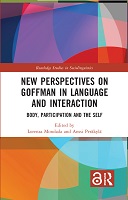
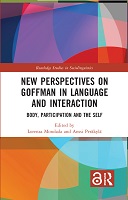
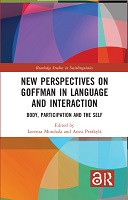
New Perspectives on Goffman in Language and Interaction
Body, Participation and the Self
| dc.contributor.editor | Mondada, Lorenza | |
| dc.contributor.editor | Peräkylä, Anssi | |
| dc.date.accessioned | 2025-03-07T22:24:09Z | |
| dc.date.available | 2025-03-07T22:24:09Z | |
| dc.date.issued | 2024 | |
| dc.date.submitted | 2023-12-19T11:26:12Z | |
| dc.identifier | OCN: 1394136079 | |
| dc.identifier | https://library.oapen.org/handle/20.500.12657/86246 | |
| dc.identifier.uri | https://doab-dev.siscern.org/handle/20.500.12854/169159 | |
| dc.description.abstract | This collection highlights new perspectives on the work of Erving Goffman, revisiting his place in contemporary social theory and interactional linguistics research and its impact in surfacing new insights in conversation analysis and our understanding of Goffman’s legacy. The volume outlines the theoretical foundations of Goffman’s research across linguistics and the social sciences. Bringing together a crossdisciplinary group of scholars, the book is organized around these themes, with sections on self and identity, participation, and bodily practices in social interaction. Each chapter comprises three perspectives— look back at Goffman’s original texts, their correlation in contemporary empirical research in conversation analysis, and a discussion of conceptual implications in relevant fields such as interactional sociolinguistics, linguistic anthropology, critical sociolinguistics, and related disciplines. Taken as a whole, the book not only offers a comprehensive critical overview of Goffman’s legacy in empirical work in conversation analysis and the social sciences but also the conceptual grounding for new studies to investigate his continuing role in contemporary scholarship. This innovative collection will be of interest to students and scholars in sociolinguistics, linguistic anthropology, and critical discourse analysis as well as sub-disciplines of sociology and psychology. | |
| dc.language | English | |
| dc.rights | open access | |
| dc.subject.other | co-presence; co-present bodies within space; social interaction; interactional sociolinguistics; interactional foundations of the self; participation; Erving Goffman; Lorenza Mondada; conversation analysis; sociolinguistics; interactional linguistics; language sciences; ethnomethodology; Anssi Peräkylä; self and identity; interaction studies; language and interaction; language and social interaction | |
| dc.title | New Perspectives on Goffman in Language and Interaction | |
| dc.title.alternative | Body, Participation and the Self | |
| dc.type | book | |
| oapen.identifier.doi | 10.4324/9781003094111 | |
| oapen.relation.isPublishedBy | fa69b019-f4ee-4979-8d42-c6b6c476b5f0 | |
| oapen.relation.hasChapter | Chapter 8 Embodied scepticism | |
| oapen.relation.hasChapter | Chapter 10 Bad behaviours, spoiled identities | |
| oapen.relation.hasChapter | Chapter 13 The social organization of (in-)attention | |
| oapen.relation.isbn | 9781003094111 | |
| oapen.relation.isbn | 9780367555771 | |
| oapen.relation.isbn | 9781032552194 | |
| oapen.imprint | Routledge | |
| peerreview.review.type | Proposal | |
| peerreview.anonymity | Single-anonymised | |
| peerreview.reviewer.type | Internal editor | |
| peerreview.reviewer.type | External peer reviewer | |
| peerreview.review.stage | Pre-publication | |
| peerreview.open.review | No | |
| peerreview.publish.responsibility | Publisher | |
| peerreview.id | bc80075c-96cc-4740-a9f3-a234bc2598f1 | |
| peerreview.title | Proposal review |
Files in this item
| Files | Size | Format | View |
|---|---|---|---|
|
There are no files associated with this item. |
|||
This item appears in the following Collection(s)
Chapters in this book
-
(2024)This chapter extends some of the observations that Goffman made on a class of vocalisations he called ‘response cries’ (1978) to the domain of the multi-modal by examining an embodied practice in English interaction: a ...
-
(2024)Elaborating on Goffman’s ideas of self and face, the chapter examines the ways in which patients with personality disorders manage the stigma of impulsive behaviours (such as verbal or physical violence) in psychiatric ...
-
(2024)“Attention” is a primordial topic throughout Goffman’s work. Already his dissertation thesis (1953) includes a separate chapter on “the organization of attention”. In his later studies he developed various concepts related ...