The Perils of Peace
The Public Health Crisis in Occupied Germany
| dc.contributor.author | Reinisch, Jessica | |
| dc.date.accessioned | 2025-03-08T00:46:32Z | |
| dc.date.available | 2025-03-08T00:46:32Z | |
| dc.date.issued | 2013 | |
| dc.date.submitted | 2015-12-31 23:55:55 | |
| dc.date.submitted | 2018-10-03 09:09:28 | |
| dc.date.submitted | 2020-04-01T14:36:28Z | |
| dc.identifier | 535462 | |
| dc.identifier | OCN: 851100424 | |
| dc.identifier | https://library.oapen.org/handle/20.500.12657/47723 | |
| dc.identifier.uri | https://doab-dev.siscern.org/handle/20.500.12854/173269 | |
| dc.description.abstract | When the war was over in 1945, Germany was a country with no government, little functioning infrastructure, millions of refugees and homeless people, and huge foreign armies living largely off the land. Large parts of the country were covered in rubble, with no clean drinking water, electricity, or gas. Hospitals overflowed with patients, but were short of beds, medicines, and medical personnel. In these conditions, the potential for epidemics and public health disasters was severe. This is a study of how the four occupiers—Britain, France, the Soviet Union, and the United States—attempted to keep their own troops and the ex-enemy population alive. While the war was still being fought, German public health was a secondary consideration for them, an unaffordable and undeserved luxury. But once fighting ceased and the occupation began, it rapidly turned into a urgent priority. Public health was now recognized as an indispensable component of creating order, keeping the population governable, and facilitating the reconstruction of German society. But they faced a number of insoluble problems in the process: Which Germans could be trusted to work with the occupiers, and how were they to be identified? Who could be tolerated because of a lack of alternatives? How, if at all, could former Nazis be reformed and reintegrated into German society? What was the purpose of the occupation anyway? This is the first carefully researched comparison of the four occupation zones which looks at the occupation through the prism of public health, an essential service fundamentally shaped by political and economic criteria, and which in turn was to determine the success or failure of the occupation. | |
| dc.language | English | |
| dc.rights | open access | |
| dc.subject.other | post-war germany | |
| dc.subject.other | public health | |
| dc.subject.other | world war ii | |
| dc.subject.other | Allied-occupied Germany | |
| dc.subject.other | Berlin | |
| dc.subject.other | Creative Commons license | |
| dc.subject.other | Denazification | |
| dc.subject.other | Nazism | |
| dc.subject.other | Soviet Union | |
| dc.subject.other | thema EDItEUR::N History and Archaeology::NH History::NHD European history | |
| dc.subject.other | thema EDItEUR::N History and Archaeology | |
| dc.subject.other | thema EDItEUR::3 Time period qualifiers::3M c 1500 onwards to present day::3MP 20th century, c 1900 to c 1999::3MPQ Later 20th century c 1950 to c 1999 | |
| dc.subject.other | thema EDItEUR::N History and Archaeology::NH History::NHW Military history::NHWR Specific wars and campaigns::NHWR7 Second World War | |
| dc.subject.other | thema EDItEUR::N History and Archaeology::NH History::NHW Military history::NHWL Modern warfare | |
| dc.subject.other | thema EDItEUR::3 Time period qualifiers::3M c 1500 onwards to present day::3MP 20th century, c 1900 to c 1999::3MPB Early 20th century c 1900 to c 1950::3MPBL c 1940 to c 1949::3MPBLB c 1938 to c 1946 (World War Two period) | |
| dc.subject.other | thema EDItEUR::M Medicine and Nursing::MB Medicine: general issues::MBX History of medicine | |
| dc.title | The Perils of Peace | |
| dc.title.alternative | The Public Health Crisis in Occupied Germany | |
| dc.type | book | |
| oapen.identifier.doi | 10.1093/acprof:oso/9780199660797.001.0001 | |
| oapen.relation.isPublishedBy | db4e319f-ca9f-449a-bcf2-37d7c6f885b1 | |
| oapen.relation.hasChapter | 3ee096cf-1d35-46ba-8e3a-83ffe8e08f6c | |
| oapen.relation.hasChapter | 2065dfc8-df15-470a-8263-d195cdeac07d | |
| oapen.relation.hasChapter | 89f5f6c0-76b3-47e2-bf75-bb90606469c8 | |
| oapen.relation.hasChapter | d6fb54fa-f8b6-4e9f-bbce-e961ec5df37d | |
| oapen.relation.hasChapter | c6b09d8a-c22c-47bc-872b-895ced65b14e | |
| oapen.relation.hasChapter | 1b05ceb8-1318-43ca-b1d5-475715b6206a | |
| oapen.relation.hasChapter | 83e78436-0560-4ac1-ad6e-1e8ccbf75ae5 | |
| oapen.relation.hasChapter | a29d0fb8-2b5e-40ab-b799-3138e67bc612 | |
| oapen.relation.hasChapter | dce4430e-748a-4578-b47b-b87e4cf00cb3 | |
| oapen.relation.hasChapter | 244b2a1c-9d7c-498b-9222-73cbfca3597b | |
| oapen.relation.hasChapter | 0d7e842a-6c8f-47fd-bb3d-c3549153a0d9 | |
| oapen.relation.hasChapter | 47122767-55de-4cd5-9e94-ab1f44eb4f67 | |
| oapen.relation.hasChapter | 0ea9c90f-76e1-468e-91a5-d8254ccb3a70 | |
| oapen.relation.hasChapter | b23b36db-d9c8-4a6e-b529-427067b777a8 | |
| oapen.relation.isFundedBy | f6fcd900-36e2-4bc9-939e-ad820802e21f | |
| oapen.collection | Wellcome | |
| oapen.pages | 337 | |
| oapen.place.publication | Oxford | |
| dc.relationisFundedBy | d859fbd3-d884-4090-a0ec-baf821c9abfd |
Files in this item
| Files | Size | Format | View |
|---|---|---|---|
|
There are no files associated with this item. |
|||
This item appears in the following Collection(s)
Chapters in this book
-
(2013)When the war was over in 1945, Germany was a country with no government, little functioning infrastructure, millions of refugees and homeless people, and huge foreign armies living largely off the land. Large parts of the ...
-
(2014)Recent decades have witnessed profound shifts in the politics of medicine and the biological sciences. Members of several professions, including philosophers, lawyers and social scientists, now discuss and help regulate ...
-
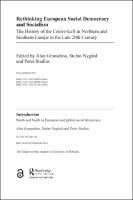
(2022)"With a combined focus on social democrats in Northern and Southern Europe, this book crucially broadens our understanding of the transformation of European social democracy from the mid-1970s to the early-1990s. In doing ...