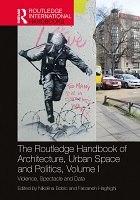
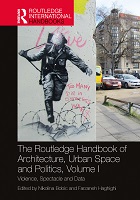
The Routledge Handbook of Architecture, Urban Space and Politics, Volume I
Violence, Spectacle and Data
| dc.contributor.editor | Bobic, Nikolina | |
| dc.contributor.editor | Haghighi, Farzaneh | |
| dc.date.accessioned | 2025-11-22T08:07:12Z | |
| dc.date.available | 2025-11-22T08:07:12Z | |
| dc.date.issued | 2023 | |
| dc.date.submitted | 2025-02-13T10:48:07Z | |
| dc.identifier | https://library.oapen.org/handle/20.500.12657/98544 | |
| dc.identifier.uri | https://doab-dev.siscern.org/handle/20.500.12854/203550 | |
| dc.description.abstract | For architecture and urban space to have relevance in the 21st Century, we cannot merely reignite the approaches of thought and design that were operative in the last century. This is despite, or because of, the nexus between politics and space often being theorized as a representation or by-product of politics. As a symbol or an effect, the spatial dimension is depoliticized. Consequently, architecture and the urban are halted from fostering any systematic change as they are secondary to the event and therefore incapable of performing any political role. This handbook explores how architecture and urban space can unsettle the unquestioned construct of the spatial politics of governing. Considering both ongoing and unprecedented global problems – from violence and urban warfare, the refugee crisis, borderization, detention camps, terrorist attacks to capitalist urbanization, inequity, social unrest and climate change – this handbook provides a comprehensive and multidisciplinary research focused on the complex nexus of politics, architecture and urban space. Volume I starts by pointing out the need to explore the politics of spatialization to make sense of the operational nature of spatial oppression in contemporary times. The operative and active political reading of space is disseminated through five thematics: Violence and War Machines; Security and Borders; Race, Identity and Ideology; Spectacle and the Screen; and Mapping Landscapes and Big Data. This first volume of the handbook frames cutting-edge contemporary debates and presents studies of actual theories and projects that address spatial politics. This Handbook will be of interest to anyone seeking to meaningfully disrupt the reduction of space to an oppressive or neutral backdrop of political realities. Chapters 1 and 23 of this book are freely available as a downloadable Open Access PDF at http://www.taylorfrancis.com under a Creative Commons Attribution (CC-BY) 4.0 license. | |
| dc.language | English | |
| dc.relation.ispartofseries | Routledge International Handbooks | |
| dc.rights | open access | |
| dc.subject.classification | thema EDItEUR::A The Arts::AM Architecture | |
| dc.subject.classification | thema EDItEUR::A The Arts::AM Architecture::AMV Landscape architecture and design | |
| dc.subject.classification | thema EDItEUR::A The Arts::AM Architecture::AMV Landscape architecture and design::AMVD City and town planning: architectural aspects | |
| dc.subject.classification | thema EDItEUR::R Earth Sciences, Geography, Environment, Planning::RP Regional and area planning::RPC Urban and municipal planning and policy | |
| dc.subject.classification | thema EDItEUR::R Earth Sciences, Geography, Environment, Planning::RP Regional and area planning | |
| dc.subject.classification | thema EDItEUR::G Reference, Information and Interdisciplinary subjects::GT Interdisciplinary studies::GTQ Globalization | |
| dc.subject.classification | thema EDItEUR::J Society and Social Sciences::JB Society and culture: general::JBS Social groups, communities and identities::JBSD Urban communities | |
| dc.subject.other | architecture,urban space,violence,war machines,security,borders,race,identity,spectacle,mapping landscapes,data,politics of spatialization,Denser,Eyal Weizman,Post-war,Follow,Pristine,Port Kembla,Digital Twin,Mirjana Lozanovska,UN,Bare Life,National Library,Golden Dawn,Spatial Imaginary,Unlimited,Quezon City,Smart Cities,Virtual Humans,Border Wall,Asylum Seekers,Ferraris Map,Algorithmic Governmentality,White Spaces,Celebration Capitalism,Saint Panteleimon,Contemporary Society | |
| dc.title | The Routledge Handbook of Architecture, Urban Space and Politics, Volume I | |
| dc.title.alternative | Violence, Spectacle and Data | |
| dc.type | book | |
| oapen.identifier.doi | 10.4324/9781003112464 | |
| oapen.relation.isPublishedBy | fa69b019-f4ee-4979-8d42-c6b6c476b5f0 | |
| oapen.relation.hasChapter | 31571e58-3109-4cb0-ae4c-3504c866a1af | |
| oapen.relation.hasChapter | b05b98ee-bc43-467e-84fa-5176568400ac | |
| oapen.relation.isbn | 9780367629175 | |
| oapen.relation.isbn | 9780367631932 | |
| oapen.relation.isbn | 9781003112464 | |
| oapen.imprint | Routledge | |
| peerreview.review.type | Proposal | |
| peerreview.anonymity | Single-anonymised | |
| peerreview.reviewer.type | Internal editor | |
| peerreview.reviewer.type | External peer reviewer | |
| peerreview.review.stage | Pre-publication | |
| peerreview.open.review | No | |
| peerreview.publish.responsibility | Publisher | |
| peerreview.id | bc80075c-96cc-4740-a9f3-a234bc2598f1 | |
| peerreview.title | Proposal review |
Fichier(s) constituant ce document
| Fichiers | Taille | Format | Vue |
|---|---|---|---|
|
Il n'y a pas de fichiers associés à ce document. |
|||
Ce document figure dans la(les) collection(s) suivante(s)
Chapters in this book
-
(2023)For architecture and urban space to have relevance in the 21st Century, we cannot merely reignite the approaches of thought and design that were operative in the last century. This is despite, or because of, the nexus ...
-
(2023)For architecture and urban space to have relevance in the 21st Century, we cannot merely reignite the approaches of thought and design that were operative in the last century. This is despite, or because of, the nexus ...