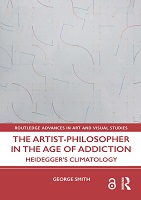
The Artist-Philosopher in the Age of Addiction
Heidegger’s Climatology
| dc.contributor.author | Smith, George | |
| dc.date.accessioned | 2025-11-22T09:58:28Z | |
| dc.date.available | 2025-11-22T09:58:28Z | |
| dc.date.issued | 2025 | |
| dc.date.submitted | 2025-02-27T09:08:55Z | |
| dc.identifier | https://library.oapen.org/handle/20.500.12657/98949 | |
| dc.identifier.uri | https://doab-dev.siscern.org/handle/20.500.12854/203605 | |
| dc.description.abstract | George Smith argues that modern humanity suffers from a late-stage, pre-fatal addiction to scientific-technological thinking. Like most pre-fatal addictions, this one will most likely result in one of three ways: misery, extinction, or human transformation. The question remains, wherein lies the third way? According to Smith, mankind’s chronic and as yet undiagnosed sickness originates in early Western metaphysics and has long been thoroughly globalized. explains unstoppable extractionism and its relentlessly increasing by-product, carbon dioxide. It also explains today’s ever-increasing rate of species extinction and the increasingly likely collapse of the biosphere. Citing climate change tolerance and denial as symptomatic of pre-fatal addiction, Smith turns his analysis to Heidegger’s "question concerning technology" and shows that even Heidegger had become "hooked" on scientific-technological thinking. Surrendering to his disease, Heidegger "steps back" into "meditative thought." This in turn opens Heidegger to an East-West mode of scientific-poetic consciousness, the thinking of artist-philosophers such as Laozi, Hölderlin, and Rachel Carson. For Heidegger, this way of thinking lays the path to mankind’s transformative emancipation from an otherwise inescapable catastrophe. The book will be of interest to scholars of the arts and culture, histories of consciousness, and climate studies. | |
| dc.language | English | |
| dc.relation.ispartofseries | Routledge Advances in Art and Visual Studies | |
| dc.rights | open access | |
| dc.subject.classification | thema EDItEUR::A The Arts::AG The Arts: treatments and subjects::AGA History of art | |
| dc.subject.classification | thema EDItEUR::Q Philosophy and Religion::QD Philosophy::QDT Topics in philosophy::QDTN Philosophy: aesthetics | |
| dc.subject.other | human,science,technology,climate change,global warming,carbon dioxide,extinction,collapse,environment,hermeneutics,logic,philosophy,art history,Buddhism,Daoist,global,metaphysics,extraction,Rachel Carson,aesthetics | |
| dc.title | The Artist-Philosopher in the Age of Addiction | |
| dc.title.alternative | Heidegger’s Climatology | |
| dc.type | book | |
| oapen.identifier.doi | 10.4324/9781003435426 | |
| oapen.relation.isPublishedBy | fa69b019-f4ee-4979-8d42-c6b6c476b5f0 | |
| oapen.relation.hasChapter | 4968e2b6-a43b-4d30-88a9-ee13d788a899 | |
| oapen.relation.isbn | 9781003435426 | |
| oapen.relation.isbn | 9781032557328 | |
| oapen.relation.isbn | 9781032564128 | |
| oapen.imprint | Routledge | |
| peerreview.review.type | Proposal | |
| peerreview.anonymity | Single-anonymised | |
| peerreview.reviewer.type | Internal editor | |
| peerreview.reviewer.type | External peer reviewer | |
| peerreview.review.stage | Pre-publication | |
| peerreview.open.review | No | |
| peerreview.publish.responsibility | Publisher | |
| peerreview.id | bc80075c-96cc-4740-a9f3-a234bc2598f1 | |
| peerreview.title | Proposal review |
Fichier(s) constituant ce document
| Fichiers | Taille | Format | Vue |
|---|---|---|---|
|
Il n'y a pas de fichiers associés à ce document. |
|||
Ce document figure dans la(les) collection(s) suivante(s)
Chapters in this book
-
(2025)George Smith argues that modern humanity suffers from a late-stage, pre-fatal addiction to scientific-technological thinking. Like most pre-fatal addictions, this one will most likely result in one of three ways: misery, ...