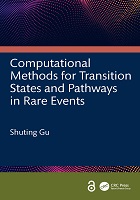
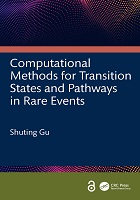
Computational Methods for Transition States and Pathways in Rare Events
| dc.contributor.editor | Gu, Shuting | |
| dc.date.accessioned | 2025-11-29T22:47:46Z | |
| dc.date.available | 2025-11-29T22:47:46Z | |
| dc.date.issued | 2025 | |
| dc.date.submitted | 2025-04-29T12:37:19Z | |
| dc.identifier | https://library.oapen.org/handle/20.500.12657/101206 | |
| dc.identifier.uri | https://doab-dev.siscern.org/handle/20.500.12854/207140 | |
| dc.description.abstract | Based on the calculation of transition states and the identification of transition paths, this book aims to provide a comprehensive guide to understanding and simulating rare events. The author introduces both fundamental concepts of transition states and pathways and advanced computational techniques, focusing on Gentlest Ascent Dynamics (GAD) and its variants. In particular, she explores enhanced numerical methods such as the convex splitting method and the Scalar Auxiliary Variable (SAV) approach within the Iterative Minimization Formulation (IMF). In addition, the book applies these methods to real-world problems, highlighting the string method and the geometric Minimum Action Method (gMAM) for computing transition paths. The book is written for researchers and practitioners in fields such as applied mathematics, physics, chemistry, and computational science who are interested in the underlying mechanisms of rare events and their transition processes. Chapters 3 and 4 of this book are each freely available as a downloadable Open Access PDF at http://www.taylorfrancis.com under a Creative Commons Attribution-Non Commercial-No Derivatives (CC-BY-NC-ND) 4.0 license. | |
| dc.language | English | |
| dc.rights | open access | |
| dc.subject.classification | thema EDItEUR::P Mathematics and Science::PB Mathematics::PBW Applied mathematics | |
| dc.subject.classification | thema EDItEUR::P Mathematics and Science::PB Mathematics::PBW Applied mathematics::PBWL Stochastics | |
| dc.subject.classification | thema EDItEUR::P Mathematics and Science::PN Chemistry | |
| dc.subject.other | Rare Events Simulation,Computational Science,Stochastic Modeling,Computational Physics | |
| dc.title | Computational Methods for Transition States and Pathways in Rare Events | |
| dc.type | book | |
| oapen.identifier.doi | 10.1201/9781003605652 | |
| oapen.relation.isPublishedBy | fa69b019-f4ee-4979-8d42-c6b6c476b5f0 | |
| oapen.relation.hasChapter | Chapter 3 Variants of Gentlest Ascent Dynamics for Transition States | |
| oapen.relation.hasChapter | 69fb350b-2131-499e-8db5-ee3348bcfed5 | |
| oapen.relation.hasChapter | Chapter 4 Enhanced Numerical Schemes in IMF for Transition States | |
| oapen.relation.isbn | 9781003605652 | |
| oapen.relation.isbn | 9781032996479 | |
| oapen.relation.isbn | 9781032997186 | |
| oapen.imprint | CRC Press | |
| peerreview.review.type | Proposal | |
| peerreview.anonymity | Single-anonymised | |
| peerreview.reviewer.type | Internal editor | |
| peerreview.reviewer.type | External peer reviewer | |
| peerreview.review.stage | Pre-publication | |
| peerreview.open.review | No | |
| peerreview.publish.responsibility | Publisher | |
| peerreview.id | bc80075c-96cc-4740-a9f3-a234bc2598f1 | |
| peerreview.title | Proposal review |
Fichier(s) constituant ce document
| Fichiers | Taille | Format | Vue |
|---|---|---|---|
|
Il n'y a pas de fichiers associés à ce document. |
|||
Ce document figure dans la(les) collection(s) suivante(s)
Chapters in this book
-
(2025)Based on the calculation of transition states and the identification of transition paths, this book aims to provide a comprehensive guide to understanding and simulating rare events. The author introduces both fundamental ...
-
(2025)Based on the calculation of transition states and the identification of transition paths, this book aims to provide a comprehensive guide to understanding and simulating rare events. The author introduces both fundamental ...
-
(2025)Based on the calculation of transition states and the identification of transition paths, this book aims to provide a comprehensive guide to understanding and simulating rare events. The author introduces both fundamental ...