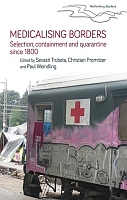
Medicalising borders
Selection, containment and quarantine since 1800
| dc.contributor.editor | Trubeta, Sevasti | |
| dc.contributor.editor | Promitzer, Christian | |
| dc.contributor.editor | Weindling, Paul | |
| dc.date.accessioned | 2021-06-19T02:03:57Z | |
| dc.date.available | 2021-06-19T02:03:57Z | |
| dc.date.issued | 2021 | |
| dc.date.submitted | 2021-06-18T13:49:26Z | |
| dc.identifier | https://library.oapen.org/handle/20.500.12657/49620 | |
| dc.identifier.uri | https://directory.doabooks.org/handle/20.500.12854/70873 | |
| dc.description.abstract | The subject of this volume is situated at the point of intersection of the studies of medicalisation and border studies. The authors discuss borders as sites where human mobility has been and is being controlled by biomedical means, both historically and in the present. Three types of border control technologies for preventing the spread of disease are considered: quarantine, containment and the biomedical selection of migrants and refugees. These different types of border control technologies are not exclusive of one another, nor do they necessarily lead to total restrictions on movement. Instead of a simplifying logic of exclusion–inclusion, this volume turns the focus towards the multilayered entanglement of medical regimes in attempts at managing the porosity of the borders. State and institutional responses to the COVID-19 pandemic provide evidence for the topicality of such attempts. Using interdisciplinary approaches, the chapters scrutinise ways in which concerns and policies of disease prevention shift or multiply borders, as well as connecting or disconnecting places. The authors address several questions: to what degree has containment for medical reasons operated as a bordering process in different historical periods including the classical quarantine in the Mediterranean and south-eastern Europe, in the Nazi-era, and in postcolonial UK? Moreover, do understandings of disease and the policies for selecting migrants and refugees draw on both border regimes and humanitarianism, and what factors put limits on the technologies of selection? | |
| dc.language | English | |
| dc.relation.ispartofseries | Rethinking borders | |
| dc.rights | open access | |
| dc.subject.other | quarantine; containment; biomedical selection; COVID-19; camp; racialisation; migration; refugees; medicalised borders; health security | |
| dc.subject.other | thema EDItEUR::P Mathematics and Science::PS Biology, life sciences::PSX Human biology | |
| dc.subject.other | thema EDItEUR::J Society and Social Sciences::JH Sociology and anthropology::JHM Anthropology | |
| dc.subject.other | thema EDItEUR::M Medicine and Nursing::MB Medicine: general issues::MBX History of medicine | |
| dc.subject.other | thema EDItEUR::J Society and Social Sciences::JH Sociology and anthropology::JHM Anthropology::JHMC Social and cultural anthropology | |
| dc.subject.other | thema EDItEUR::J Society and Social Sciences::JB Society and culture: general::JBF Social and ethical issues::JBFH Migration, immigration and emigration | |
| dc.subject.other | thema EDItEUR::5 Interest qualifiers::5P Relating to specific groups and cultures or social and cultural interests::5PB Relating to peoples: ethnic groups, indigenous peoples, cultures and other groupings of people::5PBC Relating to migrant groups / diaspora communities or peoples | |
| dc.title | Medicalising borders | |
| dc.title.alternative | Selection, containment and quarantine since 1800 | |
| dc.type | book | |
| oapen.relation.isPublishedBy | bcb4ab08-c525-4e6c-88e5-a0cf0a175533 | |
| oapen.relation.hasChapter | Chapter 9 ‘Suspect’ screening | |
| oapen.relation.hasChapter | cc318748-abd9-4ea3-91aa-21f72de5c012 | |
| oapen.relation.isbn | 9781526154675 | |
| oapen.pages | 344 | |
| oapen.place.publication | Manchester |
Files in this item
| Files | Size | Format | View |
|---|---|---|---|
|
There are no files associated with this item. |
|||
This item appears in the following Collection(s)
Chapters in this book
-
(2021)Like their peers across western Europe, Australia and the Americas, large segments of the British public and a significant proportion of Britain’s medical establishment have enthusiastically promoted medical screening (and ...
-
(2021)Like their peers across western Europe, Australia and the Americas, large segments of the British public and a significant proportion of Britain’s medical establishment have enthusiastically promoted medical screening (and ...