
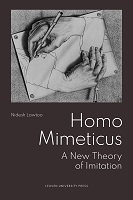
Homo Mimeticus
A New Theory of Imitation
Collection
European Research Council (ERC); EU collectionLanguage
EnglishAbstract
Genealogy of one of the most ancient and
influential concepts in western thought: Mimesis
Imitation is, perhaps more than ever, constitutive of human originality. Many things have changed since the emergence of an original species called Homo sapiens, but in the digital age humans remain mimetic creatures: from the development of consciousness to education, aesthetics to politics, mirror neurons to brain plasticity, digital simulations to emotional contagion, (new) fascist insurrections to viral contagion, we are unconsciously formed, deformed, and transformed by the all too human tendency to imitate—for both good and ill. Crossing disciplines as diverse as philosophy, aesthetics, and politics, Homo Mimeticus proposes a new theory of one of the most influential concepts in western thought (mimesis) to confront some of the hypermimetic challenges of the present and future.
Written in an accessible yet rigorous style, Homo Mimeticus appeals to both a specialized and general readership. It can be used in courses of modern and contemporary philosophy, aesthetics, political theory, literary criticism/theory, media studies, and new mimetic studies.
Ebook available in Open Access.
This publication is GPRC-labeled (Guaranteed Peer-Reviewed Content).
Keywords
mimetic studies;Mimesis;intersubjectivity;mimetic theory;contagion;simulation;crowd behaviour;identificationISBN
9789461664785, 9789462703469Publisher
Leuven University PressPublisher website
www.lup.bePublication date and place
Leuven, 2022Classification
Philosophy
Philosophy: aesthetics
Social and political philosophy
Media studies
Pages
358
Except where otherwise noted, this item's license is described
as
open access