
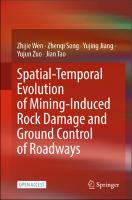
Spatial-Temporal Evolution of Mining-Induced Rock Damage and Ground Control of Roadways
Language
EnglishAbstract
This open access book presents the Coal remains the primary energy source in China, with an estimated total coal reserve of 59 trillion tons at depths of less than 2000 meters. Among these, over 50% lie at depths exceeding 1000 meters, primarily distributed in central and eastern China. Deep coal mining has become the new norm for the coal industry’s development and resource exploitation. To ensure energy supply for the rapid economic development of central and eastern regions, mining coal resources from depths of over 1000 meters is inevitable. This endeavor holds significant strategic importance for safeguarding national energy security and supporting regional economic growth. However, mining-induced hazards, such as rock bursts, water inrushes, and roof collapses, continue to occur frequently in both local and state-owned coal mines. These incidents pose severe threats to the safety of coal production, tarnish the reputation of China's mining industry, and hinder its development. Therefore, advancing mining engineering—especially the theories of major accident prediction and control—is essential. A deeper understanding of the dynamic processes underlying mining-induced pressure and strata movement is necessary. Promoting safe and efficient coal mining through informed decision-making and management supported by scientific, quantitative methods is a critical and urgent task. Achieving informatization, intelligence, and visualization in mining operations will be key to fundamentally addressing the current safety challenges in China's mining industry. In recent years, the author and their team have conducted in-depth studies on models of dynamic disasters and surrounding rock control in deep mines, supported by projects under the National Basic Research Program (973 Program), the National Key R&D Program, as well as talent and general research funds and specialized consultancy projects from the Chinese Academy of Sciences. The main research focuses include constructing spatial structural models of overlying strata in mining areas, analyzing the spatiotemporal evolution of mining-induced stress, and developing proactive control technologies for dynamic disasters in mining areas. This book aims to provide foundational insights into the occurrence and control of major mining accidents. It proposes a decision-making framework for predicting and managing such disasters by controlling the movement of surrounding rock and stress conditions induced by mining. These efforts are expected to provide a reference for advancing research in related fields.
Keywords
Coal resources; Deep mining; Mining-induced impacts; Surrounding rock control; Overburden failure; Mining-induced stress field; Rockburst; Roof disasters; Stress gradient; Large deformation of surrounding rock; Prevention and control of dynamic disasters; Spatiotemporal stress evolution; Damage evolution of coal and rock; Roof water inrush disasters; Safe and efficient coal mine extractionISBN
9789819654390, 9789819654383Publisher
Springer NaturePublisher website
http://www.springernature.com/oabooksPublication date and place
Singapore, 2025Imprint
Springer Nature SingaporeClassification
Structural engineering
Mechanical engineering
Pages
235
Except where otherwise noted, this item's license is described
as
open access